Top Tips for Renting a Crane in New York City for Your Construction Needs
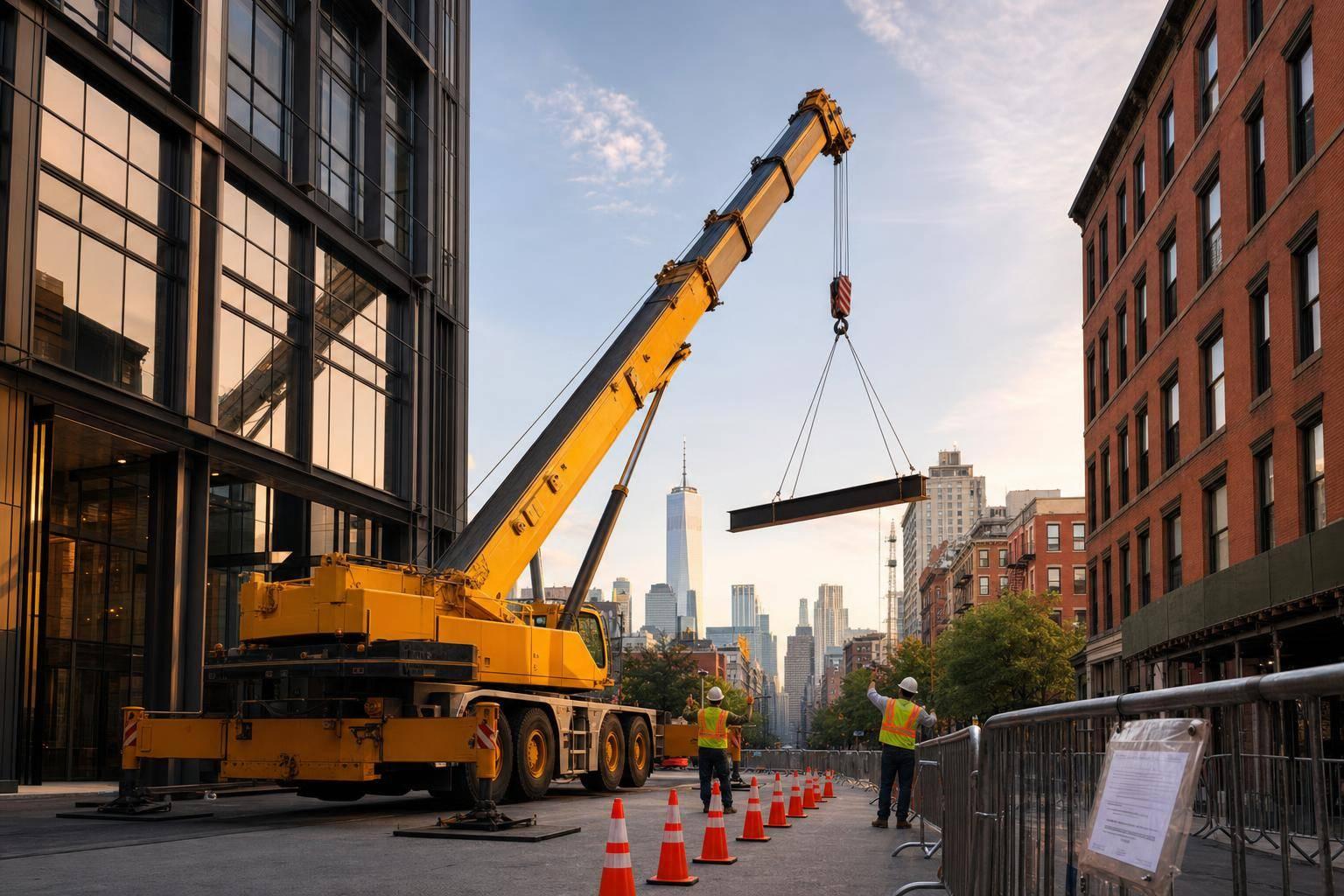
Renting a crane in NYC is not just about picking a machine. It’s about picking the right crane, getting the right permits, and making sure the site can support the lift. Miss one part, and you can end up with delays, failed inspections, or standby charges that run 50% to 75% of the normal rate.
If I had to boil this down, I’d focus on 10 things:
- Match the crane to the lift, access, and job length
- Check load weight, lift height, and working radius before asking for a quote
- Confirm DOB, DOT, NYPD, and FAA needs early
- Review street width, outrigger space, ground pressure, and underground limits
- Build the lift plan before rental day
- Verify the operator, rigger, and signal person paperwork
- Check the rental company’s inspection files and fleet condition
- Review insurance, liability, and on-site documents
- Book early, since some approvals can take 3 to 6 weeks or more
- Compare the full cost, not just the base day rate
A few numbers show why this matters. In tight city setups, crane capacity can drop 40% to 70% at long radius. A 100-ton truck crane can put 50,000+ pounds on one outrigger. And site work like crane mats can add $5,000 to $30,000+ to the job.
Quick Comparison
| What to check | Why it matters |
|---|---|
| Crane type | A crane may fit the load but not the street |
| Radius and height | Capacity drops fast as reach grows |
| Permits | Missing filings can stop the job before setup |
| Ground and access | Outriggers, tail swing, and underground limits can block the lift |
| Crew licenses | One expired credential can shut work down |
| Total cost | Mobilization, permits, labor, mats, and standby often outweigh the day rate |
If you’re planning a crane rental in New York City, I’d treat the lift as a coordination job first and an equipment order second.
sbb-itb-798c36f
Why Crane Rental Planning Matters in New York City
NYC crane lifts are rarely simple. Rooftop HVAC swaps, façade work, cell-site installs, steel erection, and precast placement all come with tight access, overhead obstructions, and rigid schedules.
Pick a crane that’s too small, or send one out without the right approvals, and the job can slow down fast or stop outright. The wrong crane choice can lead to delays, safety issues, and failed inspections.
In dense urban conditions, published crane capacity can drop 40% to 70% at maximum radius, so a crane that looks fine on paper may not be able to handle the load where it needs to. That’s the part that trips people up. A spec sheet might look good in the office, but the street tells a different story. OSHA violations can bring steep fines, and weather or scheduling delays can trigger standby charges. That’s why the first booking decision comes down to matching the crane to the load, the lift height, and the working radius.
A local provider with NYC permitting and logistics experience can help lower the risk of delays.
1. Choose the Right Crane Type for the Job
There’s no one-size-fits-all crane for an NYC site. Each type lines up with a different kind of lift, site condition, and project length. The best way to start is simple: look at the lift first, then narrow the choice based on access, reach, and how long the crane will be needed.
In New York City, access often matters more than lifting capacity. A crane might be strong enough on paper, but if it can’t get in, set up, or work without disrupting the block, it’s the wrong pick.
Here’s how that plays out on site:
- Mobile cranes are a go-to for heavy rooftop lifts, like large HVAC units, generators, and structural steel. The tradeoff is space. They need a big setup area, which often means street closures or traffic coordination.
- Boom trucks are faster to set up and fit better on narrow NYC streets. They’re a solid fit for material picks and deliveries, but they usually top out at around 30 tons and 100 to 150 feet.
- Tower cranes make sense for long-duration, high-rise work in dense parts of the city, where using a ground-based crane would be impractical.
- Crawler cranes stay stable on soft or uneven ground and don’t need constant outrigger repositioning.
- Articulating cranes can reach over scaffolding or into tight corridors where a straight boom just won’t work.
Sometimes the access issue settles the choice almost by itself. At 1162 Broadway in NoMad, a knuckle boom crane was used to install two 24-foot-tall wooden water towers on a 13-story building because it avoided the full street closure a mobile crane setup would have required on an active street corridor.
2. Calculate Load Weight, Lift Height, and Radius Before You Book
Once you’ve picked the crane type, the next step is making sure the lift works on paper. That starts with three numbers: load weight, lift height, and radius. Those figures drive both crane choice and price.
NYC Jobsite Fit
Crane capacity drops as radius grows. So don’t just measure one point and call it done. Check the working radius at both the pick point and the set point. Then confirm boom height, boom and jib clearance, and tail swing.
In a place like New York City, that matters fast. A crane that looks fine at first glance can come up short once street width, nearby buildings, or swing space enter the picture.
Compliance and Permits
In New York City, if a lift exceeds 75% of the crane's rated capacity at the working radius, it's classified as a critical pick, and a PE-stamped lift plan becomes mandatory. That’s why clean height and reach numbers matter early. If those figures are off, you could end up filing under the wrong category.
Lift Safety Planning
Your total pick weight is more than the item being lifted. It also includes rigging such as slings, shackles, spreader bars, and below-the-hook devices. Add a 10%–15% buffer to gross weight.
That buffer can save you from a costly miss. If the radius or lift height is understated and you book the wrong crane, the fallout usually shows up later as added mobilization fees, permit changes, and standby charges.
Before the rental company gives you a quote, send over:
- Load weight and dimensions
- Pick and set radius
- Lift height
- Rigging weight
- Site limits that could affect setup or swing
| Calculation Category | Required Details for NYC Rental |
|---|---|
| Load Characteristics | Net weight, dimensions, pick points, center of gravity |
| Rigging Gear | Weight of slings, shackles, spreader bars, and below-the-hook devices |
| Geometry | Radius to pick/set points, boom angle, tail-swing clearance |
| Site Constraints | Overhead power lines, subway infrastructure, street/sidewalk width |
| Safety Thresholds | Percentage of rated capacity (PE-stamp required if >75%) |
Share these figures with the rental provider before they quote the job.
3. Confirm NYC Permits, DOB Rules, and Street Use Requirements
Once the crane and lift dimensions are set, sort out the permit path before you book anything. In New York City, permits are not optional. Miss one, and you can end up dealing with fines, work stoppages, and standby charges.
Permit Types and Street Use
The permit needs to match the equipment. CD-5 covers tower cranes, CD-6 covers mobile cranes, and CD-1/CD-2 apply to hoists and derricks.
If the crane will sit on or use a city street, you also need DOT Permit 0203. That comes with a $50 fee plus a $100 inspection. Lane closures or sidewalk use may also require added occupancy permits. This part matters more than it may seem at first glance. The permit path often decides whether the crane can even reach the site.
Compliance and Permits
Keep the Certificate of Operation with the crane, and post the On-site Certificate at the jobsite. For a CD-5 tower crane permit, filing usually takes 3 to 6 weeks, so build that into the schedule.
The CN application calls for:
- Drawings
- Engineer sign-off
- Load calculations
- Any needed evacuation or transit approvals
After the permits are lined up, the next step is checking site rules that can still stop the lift.
Lift Safety Planning
Jobs near JFK, LaGuardia, or Newark may need an FAA Form 7460-1 filing. Night lifts call for lighting and DOB notice. Tower crane operations also have wind limits: work must stop at 30 mph sustained winds, and jumping operations are capped at 20 mph.
Total Project Cost
DOB registration runs from $300 for small booms under 50 feet to $3,000 for tower cranes or booms over 400 feet. Weekend inspections cost $750, and after-hours work adds $80 per day.
Add these permit and DOB costs to the quote early. If you wait until the last minute, the budget and schedule can get hit fast.
4. Check Site Access, Ground Conditions, and Setup Space
Permits give you the legal green light. Site conditions decide whether the crane can do the job.
Before you book anything, walk the site. Once the permit path is clear, the next step is simple: can the crane get in, set up, and make the lift without trouble?
NYC Jobsite Fit
Start with the crane’s route in and out. Look at street width, traffic direction, sidewalk width, grade, turning radius, and bridge weight limits. In tight NYC streets, small details can turn into big problems fast. A crane’s tail swing can strike nearby structures during rotation. And outrigger spread - often 20 to 30 feet for all-terrain cranes - needs room not just for setup, but also for staging crane parts, counterweights, and boom sections. That setup area also has to stay clear of sidewalk vents and utility covers.
Here’s the part people sometimes miss: ground pressure.
A 100-ton truck crane can load more than 50,000 pounds on a single outrigger. So the surface below the crane matters just as much as the airspace above it.
Compliance and Permits
The NYC DOB Crane Notice (CN) application calls for a location plan that shows distances to subways and nearby buildings. It also needs cross-sections of any vaults or underground structures that crane placement could affect.
That means your field measurements can’t be rough guesses. If the site dimensions are off, the filing can be incomplete.
Lift Safety Planning
Access and ground support are only part of the check. After that, you need a clear hazard map.
Review both overhead and underground risks before lift day. That includes power lines, cable runs, overhangs, pipe racks, utilities, and soil bearing capacity. Each one can affect crane placement, boom movement, or the lift itself.
OSHA requires a minimum 10-foot clearance from energized power lines up to 50 kV. Higher voltage means more distance. If utility action is needed, contact the utility company 2 to 4 weeks ahead to arrange de-energization or protective shielding. If there will be any ground disturbance, call 811 at least 48 to 72 hours in advance so underground infrastructure can be marked.
For heavy lifts, a soil report is often worth the cost. Sound bedrock can support about 10,000 to 20,000 psf, while soft clay may support only 500 to 1,500 psf. That gap is huge. It can decide whether you need engineered crane mats, steel plates, or other support measures.
Total Project Cost
Keep site-prep costs in their own budget bucket. That includes mats, plates, shoring, transport, and standby time if the crane shows up before the site is ready.
Mobilization, demobilization, and standby can add major cost, especially with large cranes. Once the site is ready, the next move is building the lift plan.
5. Build a Detailed Lift Plan Before Rental Day
Build the lift plan before rental day so the crane, crew, and site setup line up with the lift. That step turns a crane quote into a job scope the team can actually use.
The plan should spell out the lift dimensions and setup needs, including load weight, center of gravity, pick-and-set points, radius, lift height, rigging weight, setup footprint, and nearby site constraints like power lines, scaffolding, vaults, and subway tunnels.
Compliance and Permits
The lift plan is the core document for the NYC DOB Cranes Notice (CN) application. If the pick goes past 75% of the crane's rated capacity, involves a multi-crane lift, or passes over occupied spaces, a Professional Engineer (PE) must stamp the plan. A Letter of Evacuation is also required if the load passes over an occupied building.
Depending on where the crane sits, you may also need early coordination with the Transit Authority, Amtrak, LIRR, or the Port Authority when transit infrastructure is nearby. And paperwork alone won't carry the job. The crew, signal process, and stop-work rules need to be clear too.
Lift Safety Planning
The plan should name the Lift Director, identify all qualified signalpersons under ASME B30.5, and lay out the communication protocol, including radio channels, hand signals, and backup procedures.
It should also set stop-work thresholds for wind, weather, and visibility. A safety buffer of at least 10% to 15% above the calculated load weight can help avoid underestimation. Right before the lift, a structured pre-pick review checks that capacity, geometry, and weather still match the written plan.
Total Project Cost
Standby time, traffic control, flaggers, and lane closures can shift the budget fast.
Once the lift plan is locked, verify the operator, rigger, and signal person before rental day.
6. Verify Operator, Rigger, and Signal Person Qualifications
Once the lift plan is in place, make sure the people carrying it out are cleared to do the job. Check every crew member’s qualifications before work starts. If one credential has expired, the lift can stop on the spot until a licensed operator is on site. In NYC, missing paperwork can shut things down just as fast as a bad load calculation.
NYC Licensing Requirements
Start with the operator’s NYC license, then check the supporting certifications. Crane operators in New York City must hold a current NYC Department of Buildings (DOB) Hoisting Machine Operator (HMO) license. NYC also requires a Limited HMO license for articulating boom cranes, mini cranes, and rotating telehandlers.
The operator needs the right NYC HMO license for the machine and the matching national certification for that crane type, usually through NCCCO or, for mini cranes, NCCER. Keep signalperson qualifications on file with the lift package.
Lift Safety Planning
Make sure the rigger is assigned and named in the lift package before mobilization. For tower crane erection, jumping, and dismantling, specialized crews are required, and advance DOB notification is needed. Verify that the crew has signed off on the SSP and their job-specific roles.
Documentation
File operator credentials with the GC and SSM logbook before the lift. That small step can save you from delays, failed inspections, and shutdowns.
With the crew checked and documented, the next step is to review the provider’s safety record and fleet condition.
7. Check the Rental Provider's Safety Record and Fleet Condition
Once you've confirmed the crew is qualified, the next step is the machine itself. A skilled operator can't do much with a crane that's a poor fit for the site or has shaky paperwork behind it.
NYC Jobsite Fit
In New York City, crane fit isn't just about reach and lift capacity. Site limits matter too. The wrong crane or bad ground setup can stop a lift before it starts.
Ask if the provider's equipment meets Tier 4 Final diesel engine standards and uses ultra-low sulfur diesel (ULSD), since both are required for NYC jobsites. You should also confirm that the fleet data lines up with your site's ground load limits. If the numbers don't match, you're setting yourself up for delays.
Compliance and Permits
A solid rental provider shouldn't dance around paperwork. They should be ready to share current crane certificates and DOB inspection files before dispatch.
That simple step tells you a lot. If documents are hard to get now, things probably won't get easier once the crane is on-site.
Lift Safety Planning
Ask the provider to send the current lift plan and recent inspection records right away. You should also request the crane's latest annual inspection documentation under OSHA and ASME B30 standards, along with the most recent inspection report.
If they can't produce those items fast, take it as a red flag. In this kind of work, slow paperwork often means bigger problems sitting underneath.
Total Project Cost
Safety issues don't just create risk on paper. They hit your budget. One missing tag or certificate can shut down the job and cost more than the rental itself.
When you compare providers, don't look at price alone. Weigh the chance of delays, failed checks, and lost time too.
Once the provider clears safety and maintenance checks, review insurance and liability next.
8. Review Insurance Coverage, Liability, and Required Documentation
Insurance is your backstop if something goes wrong on-site. And with rigging failures or dropped loads, claims can climb into the millions. So before you sign anything, check the coverage. This isn't side paperwork. It's part of the lift plan.
NYC Jobsite Fit
Ask the rental provider to confirm General Liability insurance and make sure the policy covers third-party property damage and load drops. With a bare rental, the contractor takes full liability for both the operator and the lift.
Once that piece is clear, move to the paperwork that keeps the job moving.
Compliance and Permits
Confirm the Certificate of Operation stays with the crane, and that the On-site Certificate is posted on the construction fence before work starts.
Lift Safety Planning
Some lifts need more than a standard plan. If the lift goes past 75% of rated capacity, uses multiple cranes, or travels over an occupied building, carriers often require a PE-stamped critical lift plan.
That plan must cover:
- Load analysis
- Rigging selection
- Risk mitigation
Total Project Cost
Missing paperwork can shut a job down and lead to standby charges. Standby time means the crane is sitting idle because of documentation issues or weather holds, and it's often billed at 50% to 75% of the standard operating rate.
OSHA crane safety violations can add another hit, with fines of up to $16,550 per serious violation in 2025. Getting the documents lined up at the start costs a lot less than dealing with a stoppage in the middle of the job.
9. Book Early to Avoid Permit Delays and Standby Costs
Once the lift plan and permit route are set, lock in the crane date as early as you can.
NYC Jobsite Fit
In New York City, DOB reviews only complete CN applications, and those filings are handled in the order they’re received. That means timing matters. If you want the crane on-site by a certain date, you need enough runway to finish the filing well before then.
Compliance and Permits
Booking early gives the team time to deal with site issues before mobilization. It also gives you room to confirm ground-bearing capacity and order engineered crane pads without a last-minute scramble. That extra time can help you avoid a crane swap on lift day, which is the kind of problem that can throw the whole schedule off.
A CD-5 tower crane permit typically takes 3–6 weeks from filing to approval. Street closure permits can add another 2–4 weeks. And if the project sits near an airport, work can’t start until FAA Form 7460-1 is cleared.
Lift Safety Planning
For a complex lift, start planning 8–16 weeks in advance. That window gives you time for agency coordination, site checks, and the back-and-forth that often comes with a tough setup. The more complicated the lift, the more buffer the schedule needs.
Total Project Cost
Late booking can turn into a direct cost hit. If the crane shows up before permits are active, or before the site is ready, it may sit on standby while labor costs keep running. In many cases, standby time costs 50–75% of the standard operating rate.
10. Compare Total Rental Cost, Not Just the Base Rate
Once you’ve locked in the crane type, permit route, and lift plan, it’s time to compare the full landed cost. That matters more than the day rate.
In New York City, the base rate is just one piece of the bill. Mobilization, counterweights, permits, labor, site prep, and standby charges can end up costing more than the rental itself. In other words, a quote that looks cheap at first glance can get expensive fast.
Larger cranes often need extra trucks to move boom sections and counterweights. That alone can add 10%–25% to total mobilization costs. And in NYC, tight streets can force you into a smaller crane or a different setup, which changes the final price too.
Ask for an all-in quote that covers:
- Mobilization and demobilization
- Rigging, trucking, permits, and labor
- Site prep, standby time, and any other jobsite charges
You’ll also want to confirm who pays for weather holds and engineered crane mats. And make sure the quote says whether you’re looking at a bare rental: equipment only, or a full-service rental, which includes a licensed operator and full maintenance support.
Ground conditions can change the math in a big way. Poor ground bearing capacity may require engineered crane mats, adding anywhere from $5,000 to $30,000+ to the project.
The lowest day rate rarely leads to the lowest total cost.
Use the total-cost breakdown below to compare crane types and project inputs.
Crane Type Comparison for Common NYC Projects
Not every crane belongs on every job. This quick guide helps you match the crane type to the load, site access, and how long the job will run. Use the chart to narrow down the crane class first. Then confirm the load, radius, and permit details.
| Crane Type | Typical NYC Application | Capacity Range | Assembly/Setup Time | Best Job Duration |
|---|---|---|---|---|
| Boom Truck | Sidewalk-shed work, material delivery, lighter rooftop equipment on low-rise buildings | 8–40 tons | Minutes | Days |
| Knuckle Boom | Facade/glass installation, floor-by-floor delivery, tight streets | Up to 30–40 tons | Minutes | Daily/repetitive |
| Mobile Crane | Heavy mechanical equipment, structural steel erection, tandem/critical lifts | 50–600 tons | 1–3 hours | Days |
| Tower Crane | Ground-up high-rise construction | Variable | Days (assembly required) | Months+ |
| Crawler Crane | Bridge work, large-scale foundations, heavy steel campaigns | 50–1,000+ tons | Days (assembly required) | Months+ |
Once you know the crane class, the next step is simple: do the lift numbers and the site layout line up?
That’s where many NYC jobs get tricky. A crane may handle the weight on paper, but street width, swing space, staging room, and project length can change the call fast.
At Sunrose Towers in Upper Manhattan, a Liebherr LTM 1450 mobile crane executed a 20,000-lb mechanical pick at 330 feet, requiring 6 hours of setup, 6 hours of breakdown, and the closure of 3 city blocks.
That example shows how the choice often comes down to more than capacity alone. In day-to-day NYC work, boom trucks and knuckle booms make sense for compact, repeat lifts. Mobile cranes are a better fit for heavier picks and longer reach. Tower cranes work best for long-term high-rise jobs. Crawler cranes are better for heavy work on uneven ground.
Key Sizing Inputs to Share With a Rental Provider
Once you know the crane class, send the rental provider the exact lift data before you ask for a quote. That way, they can check whether the crane will handle the lift on your actual jobsite, not just in theory. If your numbers are vague, you can end up with the wrong crane on site.
| Input Parameter | What to Include | Why It Matters |
|---|---|---|
| Total Load Weight | Item weight + rigging (slings, shackles, spreader bars) + below-the-hook gear + center of gravity | Sets the base capacity you need. If you don’t know the exact rigging weight, add 10–15% to your estimate. |
| Lift Height Needed | Vertical distance from ground to the highest point the load must reach, plus clearance for parapets, power lines, or other obstacles | Sets the minimum boom length and angle needed to clear obstructions on site. |
| Working Radius | Distance from the crane's center pin to the load's pick or landing point | Crane capacity can drop fast as radius grows. A crane rated for 100 tons may only lift 20 tons at a 60-foot radius. |
| Boom/Jib Length | Boom/jib length needed to reach height and radius | It has to meet both the height and radius geometry at the same time. |
| Working Capacity Target | Plan the lift below 75% of rated capacity at the working radius | This helps keep the lift out of critical territory and gives you a buffer for wind and dynamic factors. |
You should also include jobsite details like street width, overhead lines, and obstruction clearance. Those factors can change both the boom length you need and the space required for setup.
When you compare quotes, permit needs, and setup requirements, use the same set of lift data each time. That keeps the comparison clean and cuts down on back-and-forth.
Questions to Ask a Crane Rental Company Before Booking
Once you have your lift data ready, use the same set of questions with each provider. That way, you're comparing apples to apples, not just looking at a low hourly rate.
- Crane fit: Which crane type and tonnage do you recommend for my load, radius, and lift height - and will the crane stay below 75% of rated capacity at the working radius? If a company can walk you through that choice in plain English, that’s a good sign they understand the lift.
- Permits and logistics: Who handles all filings - DOB crane permit, DOT street closure, NYPD coordination, and any FAA approvals - and is that included in the quote? This matters because permit work can add time, cost, and extra back-and-forth if it’s not clearly assigned.
- Crew: Does the operator hold a valid NYC DOB Hoisting Machinery Operator (HMO) license, and are qualified riggers and signal persons assigned for the lift date, or charged separately? A quote can look fine at first, then climb once crew costs show up later.
- Total cost: Ask for the full landed cost, including mobilization, demobilization, labor, fuel, mats, standby, and insurance - and confirm the standby rate if work stops for weather or site-readiness issues.
Compare proposals by scope, not just hourly price. Use those answers to line up the total project cost in the next section.
NYC Crane Rental Cost Factors at a Glance
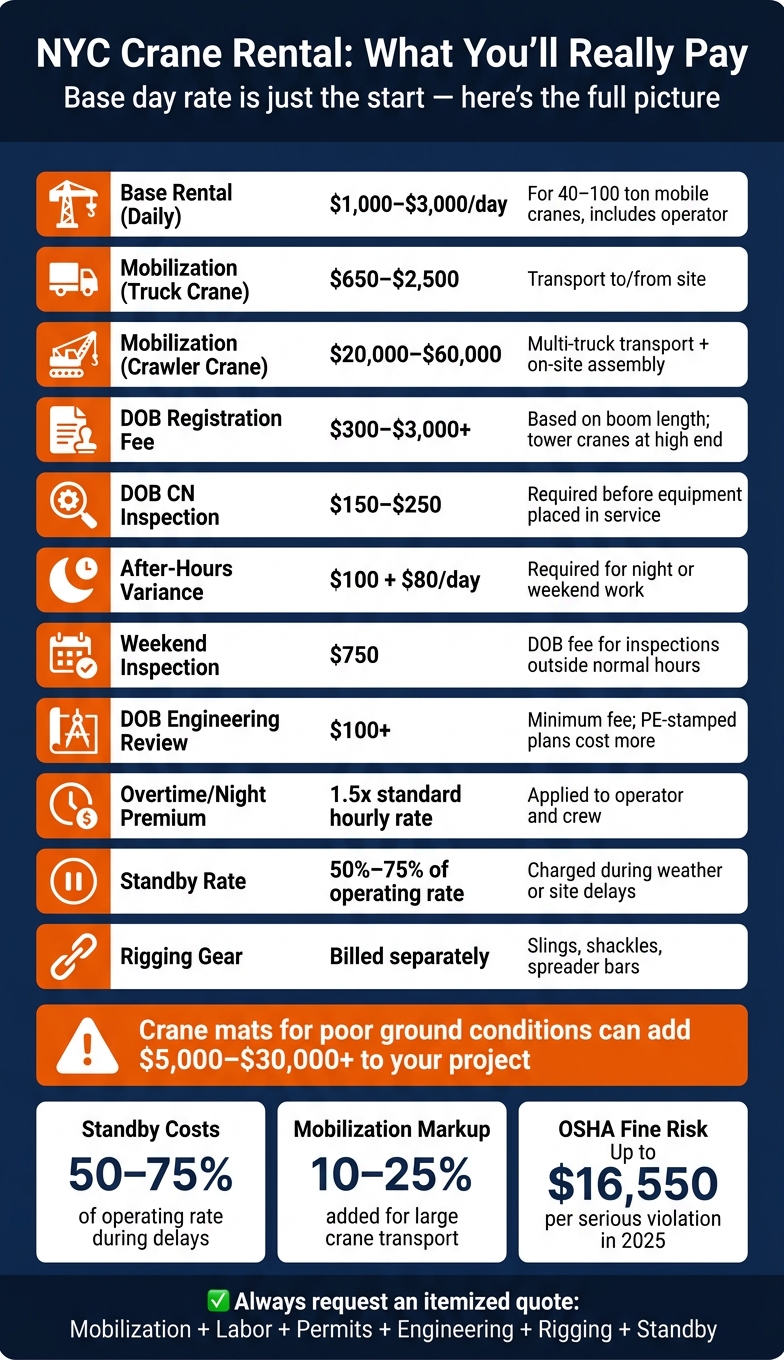
NYC Crane Rental Cost Breakdown: What You'll Really Pay
Use the breakdown below to compare proposals on the same basis.
The table also helps you line up itemized quote components side by side, so you’re not comparing one “all-in” number with another quote that leaves out half the job.
| Cost Component | Estimated NYC Rate / Fee | Notes |
|---|---|---|
| Base Rental (Daily) | $1,000 – $3,000 / day | For 40–100 ton mobile cranes; includes operator |
| Mobilization (Truck Crane) | $650 – $2,500 | Transport to and from the site |
| Mobilization (Crawler Crane) | $20,000 – $60,000 | Multi-truck transport plus on-site assembly |
| DOB Registration Fee | $300 – $3,000+ | Based on boom length; tower cranes are at the high end |
| DOB CN Inspection | $150 – $250 | Required before equipment is placed in service |
| After-Hours Variance | $100 + $80 / day | Required for night or weekend work |
| Weekend Inspection | $750 | DOB fee for inspections outside normal hours |
| DOB Engineering Review | $100+ | Minimum DOB fee; PE-stamped plans cost more |
| Overtime / Night Premium | 1.5x the standard hourly rate | Applied to operator and crew |
| Standby Rate | 50% – 75% of operating rate | Charged during weather or site-related delays |
| Rigging Gear | Billed separately | Slings, shackles, spreader bars |
In NYC, the base day rate is only part of the story. Permits, traffic control, after-hours work, and matting can push the total well past that starting number. Standby is another line item people miss, and it adds up fast, so budget 50% to 75% of the operating rate for delays tied to weather or site conditions.
When you ask for pricing, get an itemized quote that spells out:
- Mobilization
- Labor
- Permits
- Engineering
- Rigging
- Standby
That makes it much easier to compare providers before you book, and it helps you spot quotes that look low at first glance but leave out big cost items.
Conclusion
Put it all together, and crane rental in New York City gets safer, faster, and less expensive. In NYC, a smooth crane rental comes down to three things: the right machine, the right approvals, and the right crew.
Look at the total project cost, not just the daily rate. Plan early, match the crane to the lift, and check the paperwork before the truck shows up.
Related Blog Posts
Related Articles
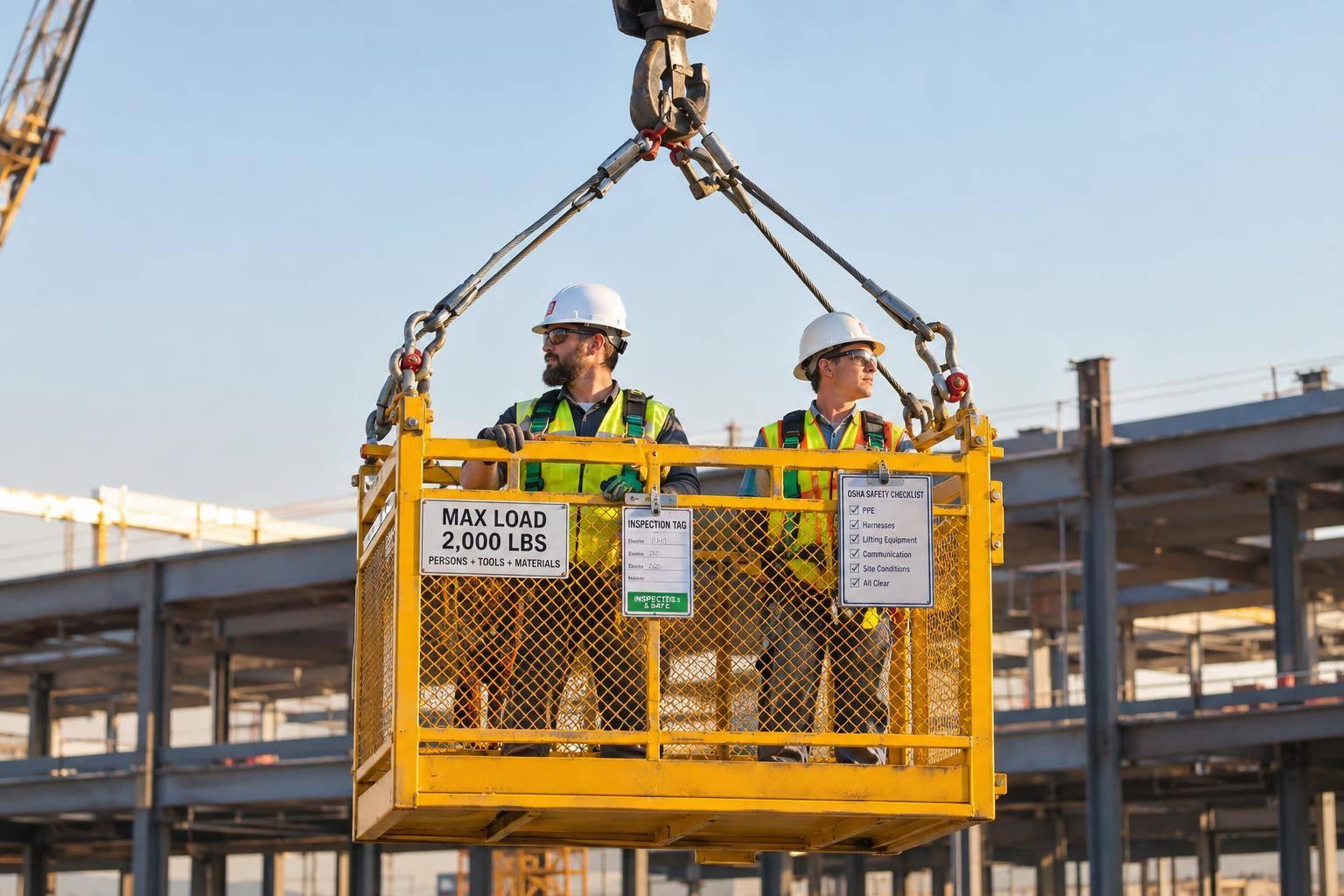
Man Basket Safety Standards: OSHA Guidelines
OSHA checklist for crane-hoisted man baskets: design, proof tests, trial lifts, fall protection, training, and rescue plans.
HVAC Tonnage Calculator
Estimate AC size in BTU/hr and tons using area, climate, insulation, and more—then compare your result with practical unit size ranges.
Crane vs Boom Truck for HVAC Lifting
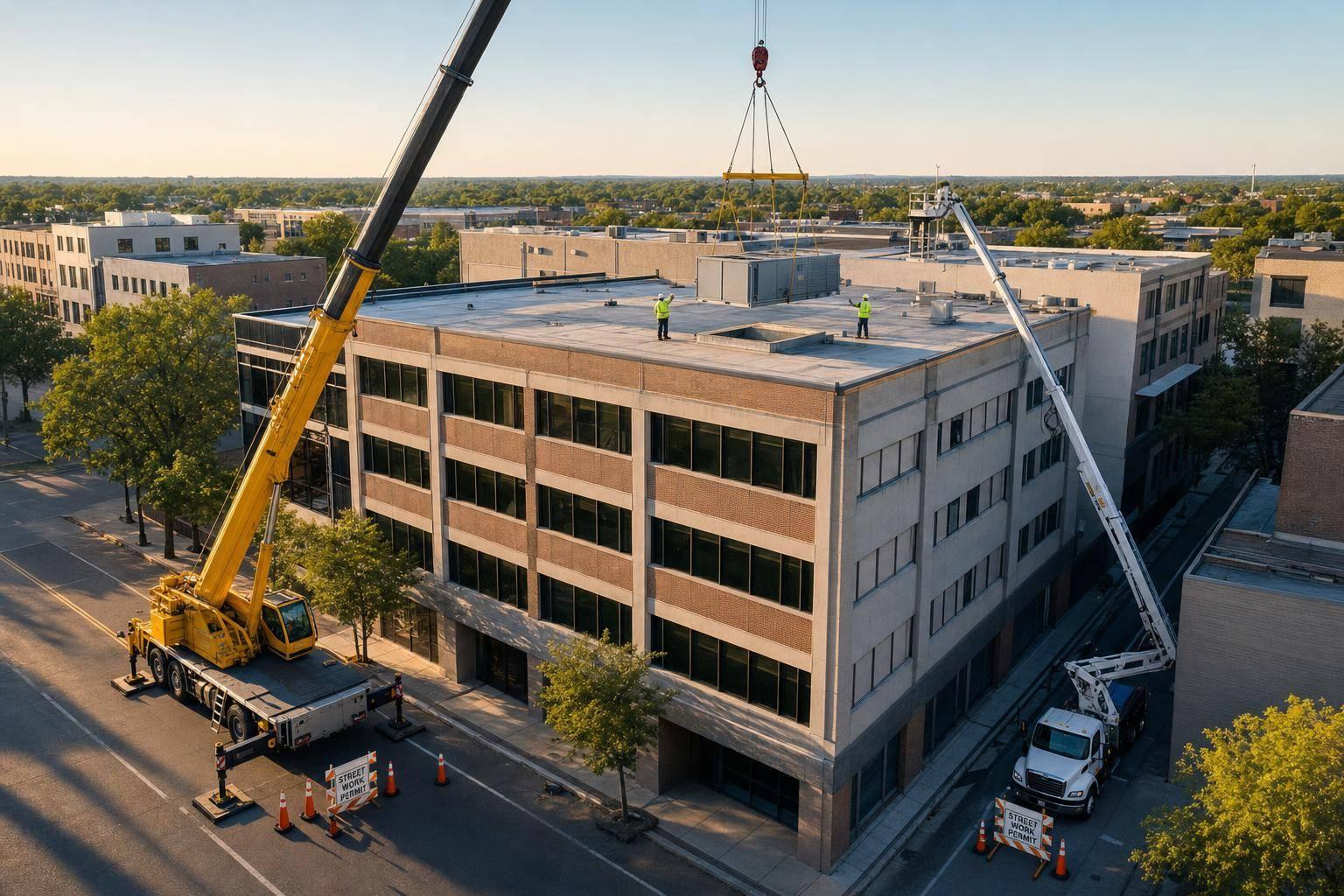
Compare boom trucks vs mobile cranes for rooftop HVAC lifts—weight, height, working radius, site access, permits, and true job cost.